Tuesday, October 30, 2012

Wes Inspired Art, Dream-Pop Nymphs, Clay, and Silver Underwear

I love my internship. Here's a bunch of cool things I found at work yesterday while browsing and researching picks for the Bay Guardian.

Wes Inspired Art
There's an exhibit of Wes Anderson inspired art in SF right now? Lol.
Through Nov 24th 

Dream Pop Nymphs
 
When I asked a friend about Twin Sister live his reply was, "Andrea is an ice fairy nymph backed by a casual collaboration of Brooklyn hipsters." He also sent me this lovely video.
They will be bringing their romantic, sultry, and physchadelic dream-pop to SF next week. Woo!
@Rickshaw Stop
Wednesday/11

Clay
 
Really cool sculpture from the film Dimensions of Dialogue (1982) by Czech animator, Jan Svankmajer. It reminds me of Magritte's the Lovers, which is one of my favorite cynical romantic paintings. Svankmajer's films are gruesome dark comedy often with a philosophical edge. These will also be showing in San Francisco in the upcoming weeks.
A variety of dates

Silver Underwear 
Juergen Teller, Self-Portrait with Charlotte Rampling (from Louis XV)
“Charlotte arrived, and I was totally starting to sweat. She said, Now what are we going to do? I said, I’m going to show you what I’m going to wear. So I went into the bedroom, and I came out in these silver underpants. And she said, What the hell is that? I was smoking my cigarette, breaking out in a sweat. I said, Well, I was just thinking I could kiss you and fondle your breasts. She sat down and got herself a cigarillo. She didn’t say anything. The whole room was quiet for what seemed like months. I was, like, Oh my God, that is the most stupid thing I’ve ever said, how stupid was that? She just dragged on the cigarillo and crossed her legs, and she said: OK, let’s go. I’ll tell you when to stop. I thought, Oh my God, genius. I can’t believe I’m getting away with it.”

Juergan Teller's fashion photography has great use of color, mildly unsettling compositions, and content that pushes everyone's boundaries. Maybe its that he's a rare heterosexual male who is actually attracted to his subjects and not a gay man who just wants to take pictures of sexy women. Any which way, I found him on probably the Artisty-est fashion blog I've seen in a while, Creative Unique. Like really, how many people think to look at Nim Chimpsky for style inspiration? Their Daily Unique supplement has a boatload of good recommendations including Grace Jones, Geometric Porn, and the Architectural Avante Garde.

Wednesday, October 3, 2012

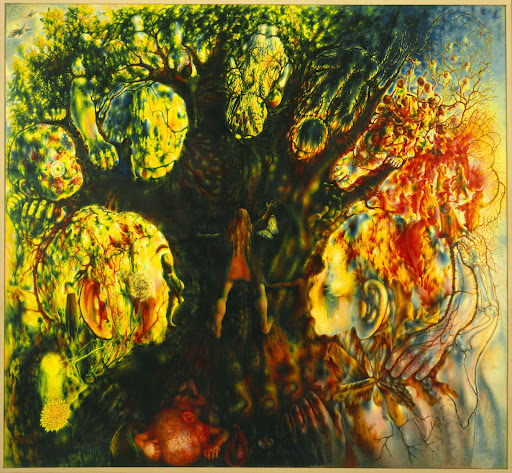
Before there was Alex Grey...

I saw one of Pavel Tchelitchew's paintings in the Gertrude Stein exhibit at the SFMOMA last summer. I wrote his name down because the post-apocalyptic feel of it was a striking contrast with the preceding paintings of abstract art-world inside jokes and serene scenes of luxurious dresses lounging on pretty women in impressionist France (yeah you Matisse.) It wasn't until I google searched him while procrastinating this morning that I was like, 'Holy shit, Alex Grey who?' (The link is there in case you are also going, 'Alex Grey who?' but for different reasons.) Call me a hipster, but this guy was making acid-trip art before acid-trip art was cool. And furthermore, he did it with a conscious.
Note: Its pronounce Chell-e-shetf in case you were wondering.
 

Saturday, September 8, 2012

Infinite Jest: just a really long book with no end or a mind-blowing fusion of the epic tradition and social science fiction?

     I have to apologize in advance, I will not do a very good job of answering my question from the post title. It was just one of the many I was left with after reading Infinite Jest and I have to admit, it sounds pretty good. I still am not sure what to make of the book and how much I can say without totally spoiling it.
     Nevertheless, here are my thoughts. I can't help but see its slightly twisted connections to the epic tradition since I just finished a class on them. It has the same tropes but turned on their head-- one of the more pitiable characters emerges at the end as the true hero, while the original protagonist begins his fall around the climax of the book (if it can be said to have a climax at all). Heaven and hell are unexpectedly convoluted in the halfway house and tennis academy. Its similies are never grandiose, in fact they are usually only ironic, and the muse invoked is painfully basic yet fails to hear its call.
     Infinite Jest does however, present an impressive insight into American entertainment and values. We get this through a serious of interrelated yet unconverging stories of drug use, tennis, family history, and other miscellany. These are interspersed with the philosophical discussions of a single encounter between an undercover American agent and a handicapped Canadian assassin.
Infinite Jest poses the problem of what we chose to enjoy versus what we are drawn or often succumb to enjoy and further the negative effects that succumbing can have. These discussions as well as the more immersive examples in the stories form the substance that I think the book seeks to communicate, that is, a greater agency within the limits of ones own life.
     In each situation the limits of each character are clearly defined, but what is truly loveable about the book is how each one manages to express himself in a totally unexpected way. My favorite example is Mario, the third brother of the Incandenza family and the only one not to be enrolled in the elite Enfield Tennis Academy. He is afflicted with an unspecified mental illness, despite which he is incredibly cheerful and manages to explore his own personal interest in film. He hobbles around in the tunnels between tennis courts with a camera strapped to his forehead taking pre-match footage of the students. It is this simple, unconventional type of charachter that I think gives the reader a great sense of joy in reading, one that is easily translatable to one's own life.
    Although the realism and understanding with which Wallace portrays each of his characters and their actions is truly impressive, the most innovate technique with which he creates a sense of realism is his use of climax and anti-clamax. The book covers a wide range of experiences that it would be hard for one person to experience, yet it remains entirely accessible. This is because each persons story is beleivable, it sounds like the wild anecdote one might share over a few drinks at a party. Yet this "epic" doesn't cash in on its dramatic conclusion. Even the meeting of Bloom and Dedalus in Ulysses is more of spectacular occurance than what we see in Infinite Jest.
     It seems to be teaching then, in addition to the message I mentioned earlier, which one picks up rather quickly, that it is not about the top of the mountain, or the epiphany moment, but more about the steps it takes to get there. It orients the readers towards the possible future of the book, rather than the problem solved in it. Which I think makes it quite unique and definitely puts it in the running for social science fiction/ epic of the decade. Though I really should have explained what that means....


Friday, July 27, 2012

Lost. Misplaced.

I'm feeling a bit lost in the world right now. Almost finished with my painting. In the meantime, here are some songs I've been on. You could say they peice togethor my current philosophy. Also, I've been reading in rotation: Infinite Jest, Adorno's Aesthetics, and Zen and the Art of Motorcycle Maintenance. All of which are good and will merit full reports when I've finished them.
I see them as helping beef up my careful, analytic skills and bring them up to speed with my intuitive ones.

Neko Case- Buckets of Rain (Couldn't find the Bob Dylan version but I approve of this).
http://www.youtube.com/watch?v=r_Uvy0g3MMM

Nico Vega-Gravity
http://www.youtube.com/watch?v=ZOkKufaZ84s

David Bowie-The Man Who Sold the World
http://www.youtube.com/watch?v=6x5OubSeb-U

Junip-Always
http://www.youtube.com/watch?v=BYB0iEiOuzs